
The Walls Have Mouths
Translated by Anjel Fierst
This article was originally published in Western Armenian by Sosy Mishoyan, commenting on how many Armenian expressions mention walls through the strange, comedic, and sometimes beautiful messages found across Yerevan. In an attempt to provide as close a translation as possible, some idioms are rendered literally, and footnotes are provided for specific cultural or linguistic references that do not translate directly.
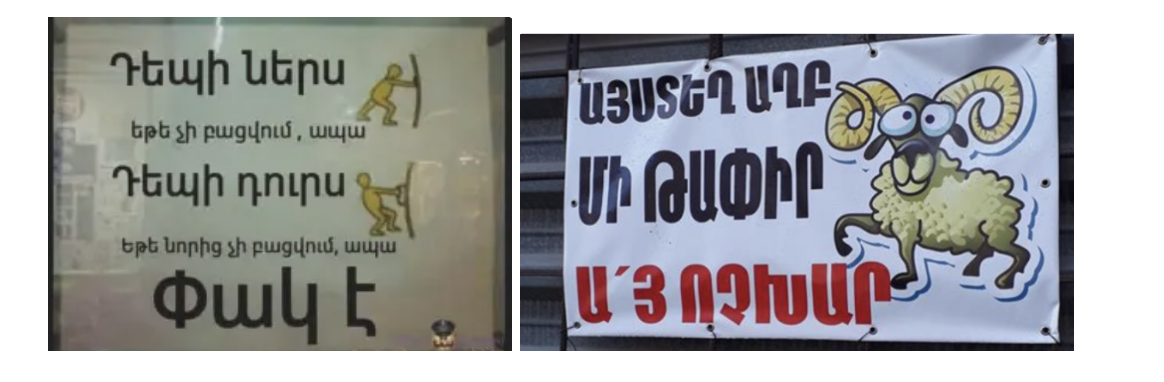
Caption (Left): If you push the door and it doesn’t open, then pull. If the door still doesn’t open, then it’s closed.” Caption (Right): “Don’t litter here, you sheep!” (A common insult. Akin to calling someone an ‘ass’ in English.)
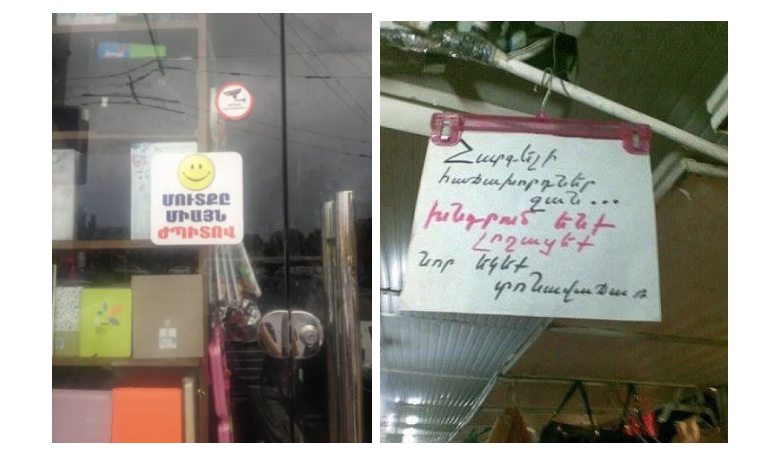
Caption (Left): “Enter with a smile.” Caption (Right): “Dear customers, please bathe before you enter; you stink!”
We often hear the expression, “Be careful! The walls have ears!” They’re listening!” Well, if the walls have ears and they’re listening, then they must also be able to speak. Although sometimes there are also “deaf walls” if you’re saying that your voice remains unheard. Knowingly or unknowingly, the walls are present with us. Sometimes, when alone in contemplative thought, “we talk with the walls." Sometimes the “four walls” (an expression that means to be alone with your thoughts) press in on us and become so narrow that we want to escape them, to pull down the walls and stretch wider than their limits allow. Nevertheless, when we are outside the walls, they still don’t give up their influence on us. When, in order to go from place to place, you want to ride the minibus, its walls get tired of your talkativeness. The walls warn you to put your phone away and sit quietly so that no one overhears you gossiping about your mother-in-law, teaching your recipes, or revealing your heart.
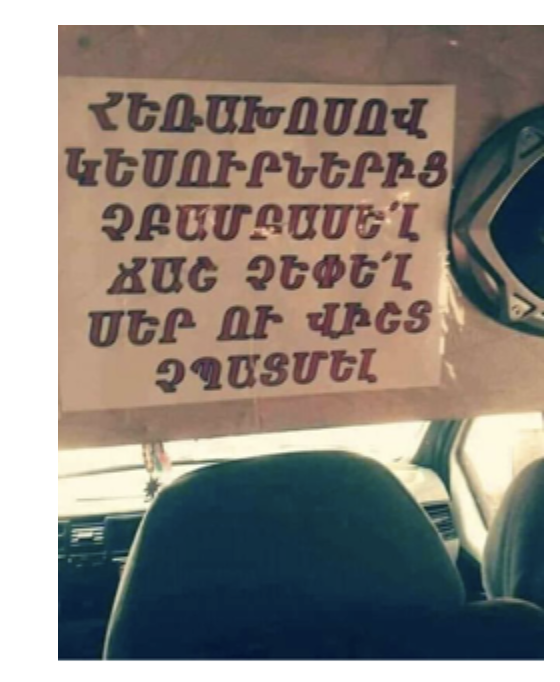
Caption: “On the phone, do not gossip about your mother-in-law, do not teach our recipes, and do not tell your pains."
When, in order to shop, you want to go to the bookstore, the wall commands you not to enter with a frown on your face. Instead, you must follow the instruction,“Enter with a smile.” "When you want to walk alone on the sidewalk, you don’t know what intentions the wall is suggesting to you, so you remain quiet. Don’t worry if it’s saying something rude; of course it knows something!
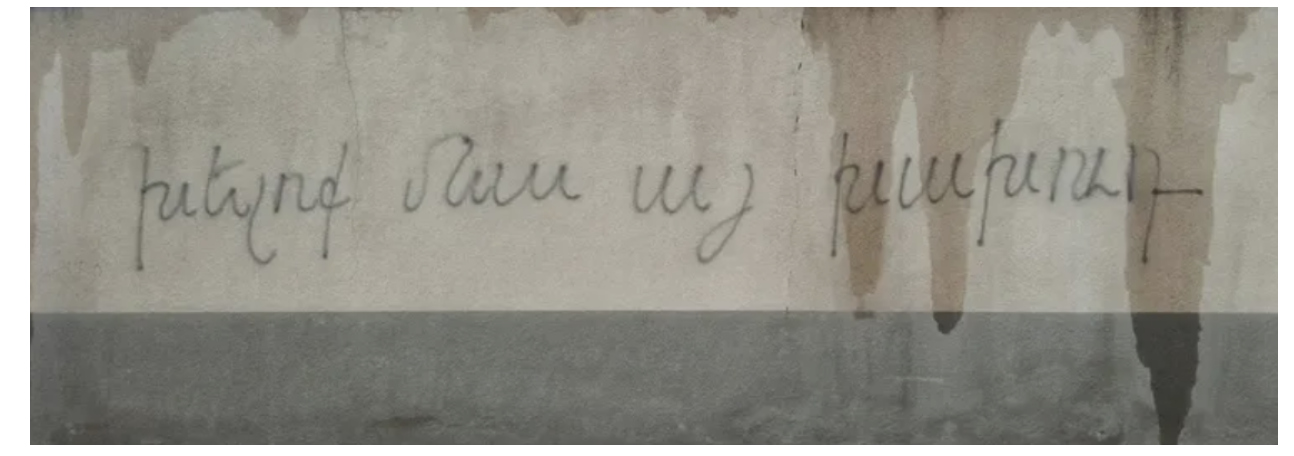
Caption: “Behave good, you rascal."
When nature calls and you run to the women’s restroom, the wall there has a message for you: “You should be ashamed! Flush this time!” You follow its order obediently, wondering what possibly could have happened to require this … who knows!
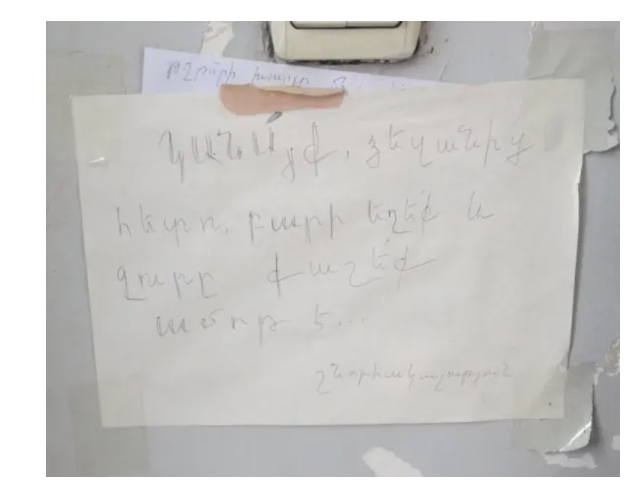
Caption: “Ladies, after you go, leave well and flush. It is your shame. Thank you.” (Shame is a commonly used admonishment in Armenian, so this, though mortifying, is not quite as extreme as it may sound in English.)
Yes, the wall is particular and commanding.
“Don’t touch!”
“Don’t block the entrance!”
“Don’t litter!”
“Oh well, at least it’s true that your instructions will be heard,” you think to yourself, and you pass.
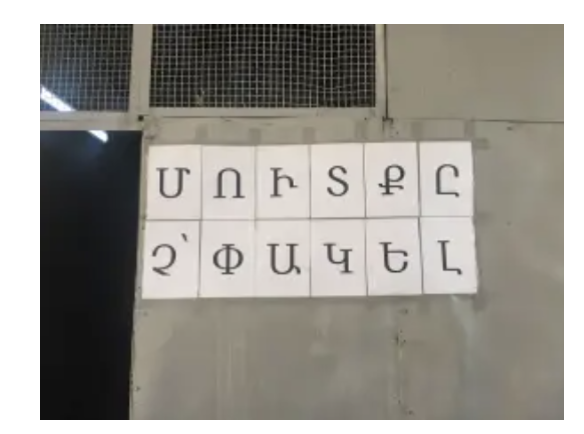
Caption: “Do not block the entrance”.
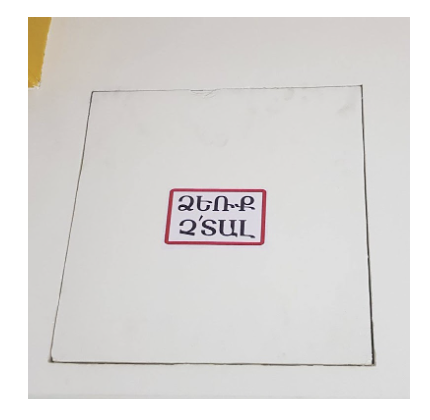
Caption: “Do not touch””
The wall needs to ask, “Will this boy pack or will that boy?” The wall is very serious, and it demands a “boy who packs" and a “girl who sorts." Then, it promises rewards to the finder of a coin purse and the deliverer of a lost dog. The wall decides who you vote for and who you refuse to praise. It encourages you “towards new victories” and shows you the path.
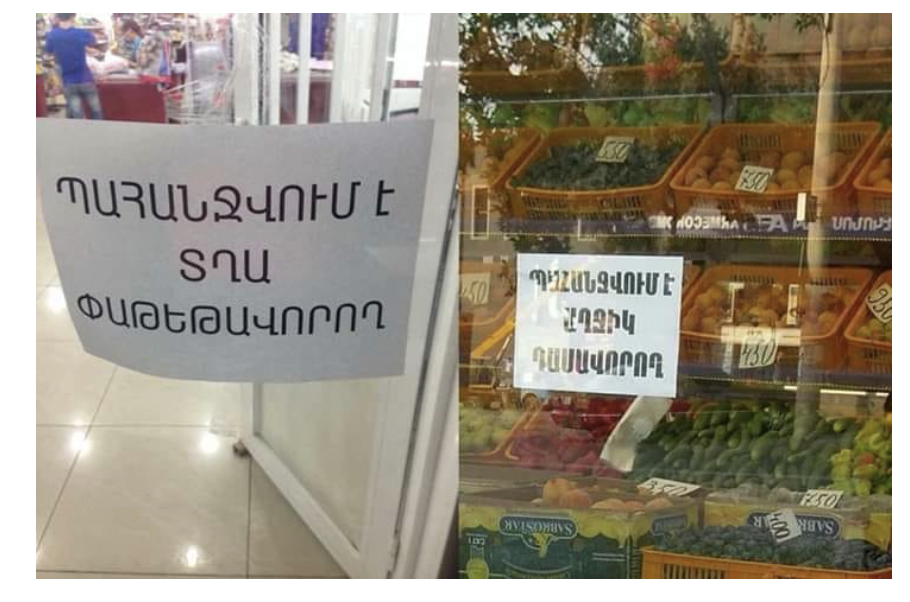
Caption: “Hiring a packing boy." “Hiring a sorting girl”
Sometimes, the wall is also romantic and confesses love. Involuntarily, you are alarmed. You want to help him find her, far-away Sofia. You are human; what will be will be, and what won't be won't.
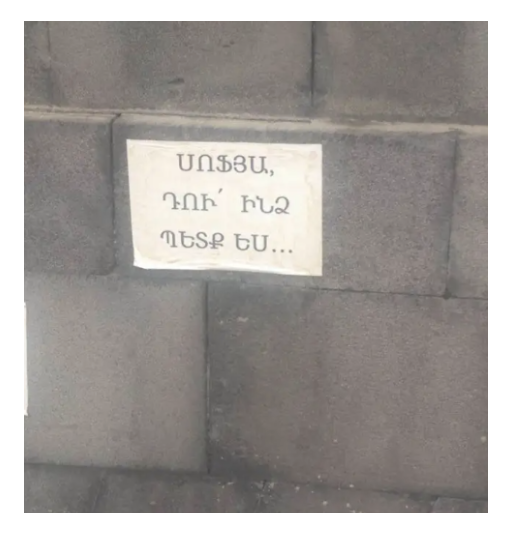
Caption: “Sofia, you are my [heart’s] need."
The walls are transparent, especially in villages. Alas, when he makes an appointment to get acquainted with someone, the entire village already begins wedding preparations. In popular gossip, the wall has its own master. For the man swaying drunkenly, the people say, “He has come home in a state of wine; one wall is for me and one wall is for you.”
“One wall gold, the other silver” is said in regard to a man swimming in fortune.
“The wall is stuck"; that is to say, there’s a firm relationship between neighbors.
“He’s wall colored” is the expression given for pale, sick people.
We often hear the expression, “He’s a crack in the wall,” to pity people with an unfortunate appearance.
“He’s a sin.” (An insult to the appearance that also has moral connotations.)
“He’s not! He’s a crack in the wall; why ignore what he says?”
“He nails the wall” means to give a sharp insult.
The phrase, “He enters the wall or he closes the wall,” means if in tight straits, he will be betrayed.
For young men it is often said that they are “outside walls," and for young women, “inside walls." (These expressions are rooted in ideas of separate spheres, where women belong in the home and men in the outside world and can be compared to the English “a woman’s place is in the kitchen.’’) Though now, enough are clear that inside or outside walls should not be the standard for young women and men. It is important, however, that “frozen walls” will not suddenly come up between a couple. That they build their four walls and the course of their life’s voyage together so they don’t meet ramparts or “stone walls” (an idiomatic way to say "obstacles").
The article in Armenian. in the Hayeren blog